StatCounter Code for Blogger / Blogspot -->

Monday, July 18, 2011

FINISHING TOUCHES TO A DOLL OUTFIT


I dressed this sweet 12" Bru in a vintage dress. I added silk ribbon streamers, and ran satin cording and ribbon through the lace . I added matching silk ribbon trim to the vintage French lace bonnet. Shoes are Bru style, but not old.  Socks are hand crocheted.
Posted by Picasa

Sunday, June 5, 2011

PROGRAM ON CHINA DOLLS


Covered Wagon hairdo, about 1840-50, pink tint.


Flat top hairdo, about 1860, rare brown eyes.


Highland Mary hairdo on left made by Kling, about 1880. Alice in Wonderland hairdo on right, about 1870-1880.

China dolls (glazed - shiny - porcelain) were made mostly in Germany beginning in the 1700's, but didn't become popular until the 1840's. Literally billions were made, and though they were play dolls and many were broken, there are still good examples today for collectors to treasure. Many hair styles were made, depending on the styles of the times; it's possible to date a china within about 20 years. A hair style was made as long as it was popular. Blonde chinas were made in the 1880's, whereas before that, they had black and brown hair, brown being rare. Pink flesh tints were used early on. Chinas lost popularily during the latter part of the 1800's, due to the popularity of bisque (unglazed) dolls; also child-like characteristics in chinas appeared in competition with bisque child dolls. The low brow common type china doll was made from the 1890's to the 1930's. Bodies were either handmade fabric at home or purchased fabric from a manufacturer of bodies such as Goldsmith; many of the manufactured ones had corsets. Some china dolls had leather bodies or leather arms. Many had china legs and arms; early hands were spoon-shaped, and later ones were cupped.. Boots before 1870 were flat-soled and with a heel after 1870. Chinas came in many sizes and with various hairdos; most of the original prices were just a few dollars. Most chinas are unmarked.  Some collectors say they are cold and serious-looking, which is true, but during the time they were made, it was a serious business to be a child, with many adult lessons to be learned.
Posted by Picasa

Thursday, June 2, 2011

Tuesday, May 17, 2011

FREE DOLL APPRAISALS AT OUR ANNUAL DOLL SALE


Here is the proud owner of an 1860 lady china (shiny glaze) and boy china of approximately the same period (he has replaced body and limbs).


Here is Linda with Jean by J.D. Kestner. Our expert doll doctor Dorothy repaired the sleep eyes, which was a difficult job since there is only a small opening in the neck.


Here is Colman, he proud owner of French and German antique all-bisque dolls. She is holding a French "Mignonette," a much-desired doll by collectors.


Here are the all-bisques up close. Wouldn't you like to have a pocket-full?
Posted by Picasa

BIRMINGHAM DOLL CLUB OF ALABAMA ANNUAL DOLL SALE


Here are some of the variety of antique and modern dolls at our Annual Doll Sale, which occurred last weekend, May 14.


Posted by Picasa

Tuesday, April 19, 2011

NANCY ANN STORYBOOK DOLLS - PHOTOS AND INFORMATION


NASB dolls from 1937 through 2011 (overview notes for doll club meeting on 4-10-2011)

On February 22, 1901, Rowena Haskin was born in Lake County, CA. As the years went by, she attended CA School of Fine Arts, changed her name to Nancy Ann Abbott, and moved to Hollywood. She danced and acted in Universal Studios silent movies, and became a Hollywood studio designer.

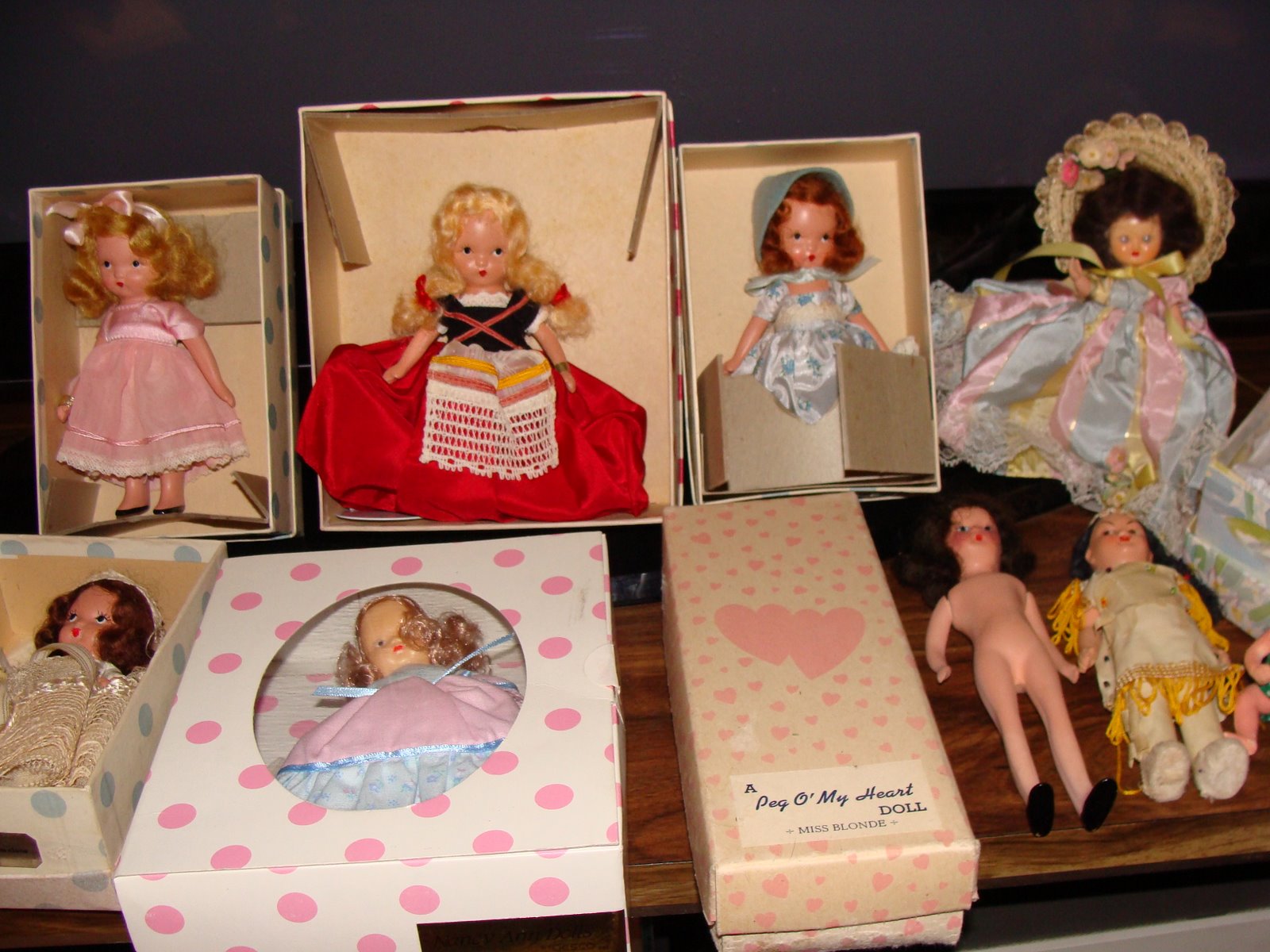
Her zeal for costume design became a consuming passion. By 1936 she was designing costumes for small bisque baby dolls that were made in Japan and giving them as gifts. Soon she was operating an actual business selling these small dressed dolls. Allan Leslie Rowland and Nancy Ann Abbott purchased a 400 sq. ft. shop with 4 employees and incorporated The Nancy Ann Dressed Doll Corp. on Feb. 23, 1937. In 1938, the company opened its own pottery plant in Berkeley, CA, to make its own bisque dolls, using its own molds. Nancy Ann Storybook Dolls were now being sold nationally. If you were a little girl growing up in the 1940s/1950s, you probably owned a Nancy Ann Storybook doll. These little dolls were made of bisque pottery.

Beginning in 1947 the company converted to plastic dolls. However, the wonderful costumes were still outstanding. Also, the dolls came in recognized boxes, which were white with either pink or blue polka dots. As always, there were doll companies who cam out with NASB look-alike dolls. K&H (Kerr & Heinz) looked closer to the real NASBs; one of the main noted differences is K&H dolls' feet were larger. Princess Dolls and Mayfair Dolls were also look-alike dolls.

Nancy Ann Abbott died of cancer on Aug. 10, 1964. Without here leadership the company closed its doors in 1965. Mr. Albert Bouria obtained the right to the name of the company in 1966 from the bankruptcy court at an auction. The Albert Bouria years of owning the company was from 1966 through 1973. After using all the dolls that were produced during the last years of Nancy Ann Abbott's life, Albert Bouris began using hp dolls with sleep eyes and painted eyebrows, and they were produced in Hong Kong. Production then transitioned to a 5 l/2" vinyl doll with rooted synthetic hair (instead of mohair) and black plastic slilp-on shoes. He used several kinds of boxes, usually with see-through lid or covering.

In 1986 the Jesco Co. marketed dolls using the name of the Nancy Ann Storybook Doll Co. These dolls were removed from the market when Mr. Bouria's attorney informed the company to "cease and desist" the use of the Nancy Ann Storybook Co. name and trademark.

In 2003 2 sisters, Claudette Buchler and Delene Budd legally purchased the rights to the company's name from Mr. Bouria (after the co. was listed on Ebay). These 2 sisters wanted to keep the innocent child of the original Nancy Ann bisque mold. They made the new 6 l/4" dolls of porcelain and fully jointed. The costume designer hired was Londie Phillips; the doll designer brought on board was Diane Effner. Claudette and Delene were delighted with the new little Nancy Ann Storybook dolls.

You may purchase one of these new wonderful little NASB dolls on the internet listed http://www.nancyannstorybookdolls.com. And you can still bid on old Nancy Ann dolls on ebay.


Posted by Picasa

NANCY ANN STORYBOOK DOLLS

Janet gave an informative and interesting program on Nancy Ann Storybook Dolls, which many of us owned during the 40's (I, for one). Here are some of her examples.


Posted by Picasa

Tuesday, April 5, 2011

'NEW' DOLL CLOTHES; VALENTINE BOX DISPLAY


 Here is Christine's (former member) Frenchy Simon Halbig (has pink kid body) wearing her ebay antique bonnet.  Think it's over the top?  Never mind.  She can carry it off.


I found this AM Mabel at the Tupelo, MS Doll Show.  Also bought the dress.  A dealer had lots of doll clothes for sale made by an Englishman from antique cloth and lace.


 My SFBJ has been without an outfit for years, and I found this at the Tupelo Show.


Here is an idea for doll display using valentine candy boxes.  The dolls are wired in through holes punched in the box.  NOTE:  I just realized they could benefit from a lacy or doily edging.

Tuesday, March 29, 2011

HINA MATSURI (DOLL FESTIVAL) EXHIBIT AT UNIV. OF AL


(Click on photos to enlarge)

These precious dolls representing the royal court have been handed down from generation to generation.  Originally a purification ritual, Hina Matsuri (March 3 in Japan) represents a day of hope for the growth, happiness and future of young girls. One legend says that if a girl displays her dolls for more than 3 days, she will marry later in life.


Thursday, March 10, 2011

WOODEN DOLL CARVING CLASS BY JANET CORDELL


The Birmingham Doll Club of AL sponsored a Wooden Doll Carving Workshop March 3-6, led by Janet Cordell. There were many happy and talented carvers working, and with her direction, turned out some amazing works. A few had never carved before, and were doing an excellent job. Someone years ago found an old wooden doll in an antique shop named Hitty, and this inspired a book HITTY, HER FIRST HUNDRED YEARS, which has inspired many to carve their own wooden dolls.


Here is the group of proud carvers.


Some carved the Hitty doll, but Sharon learned to carve a tuck comb doll.


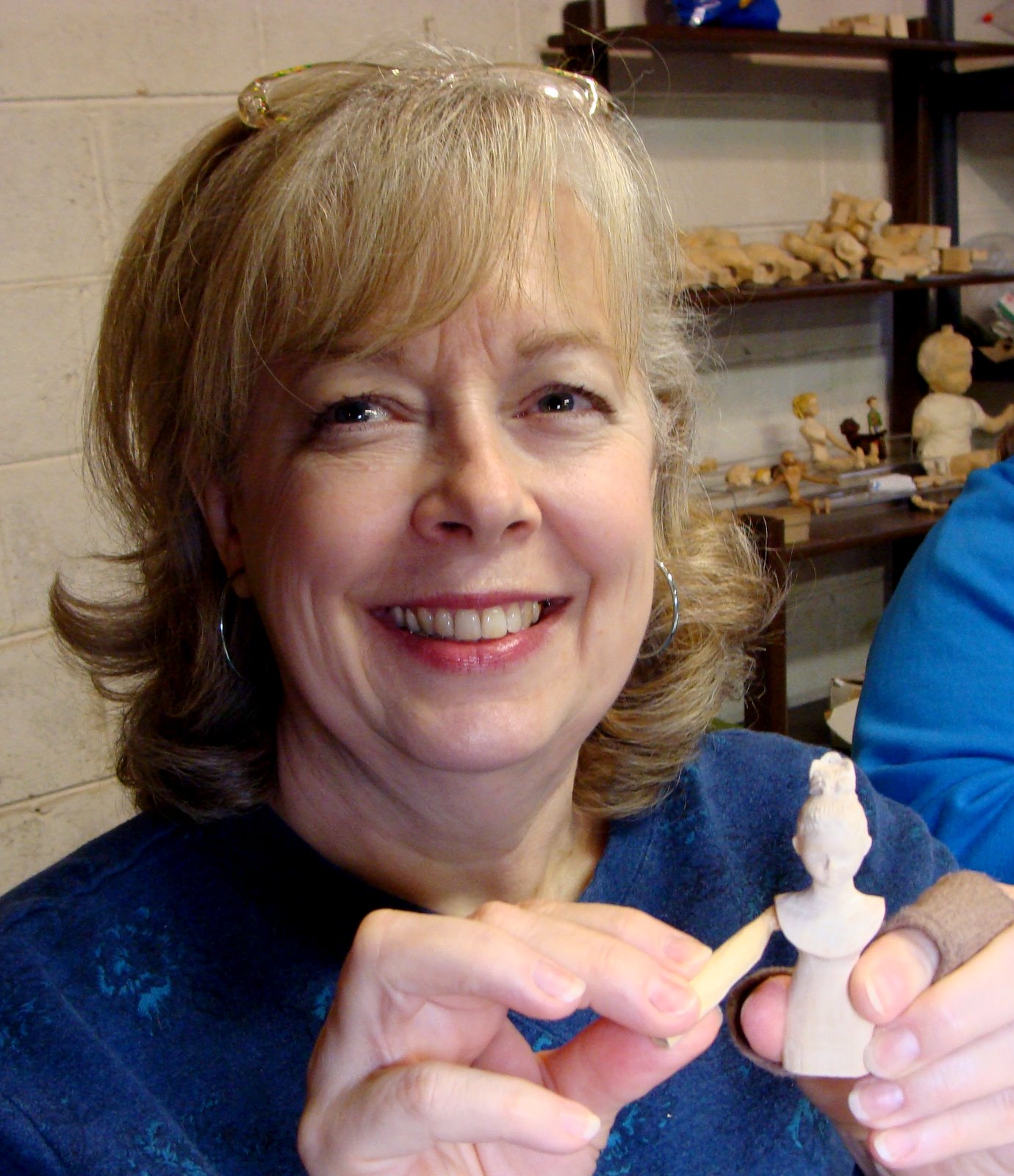
Here is Janet with her tuck comb doll, partially finished.


Here is the Hitty book surrounded by finished examples of Hitty dolls and a Grandmother doll.
Posted by Picasa

Monday, March 7, 2011

WOOL FELTED ANIMAL SHAPES FOR YOUR DOLLS OR YOURSELF

We saw these marvelous wool felted animals by Kathy Bailey (from Oklahoma) at the Tupelo, MS Doll Show. By using long felting needles and continuously poking while shaping, you can come up with some realistic shapes. Our doll club had a felting workshop last year, and we were amazed at what we could do. Here are sites that give tips on felting and a felting tutorial:

http://chushka.com/felting_tips.html

http://www.youtube.com/watch?v=wcfbgtyrz2U


Posted by Picasa

Sunday, March 6, 2011

PHOTOS FROM TUPELO DOLL SHOW & SALE MARCH 5


Some of our Birmingham Doll Club of Alabama made the trip to Tupelo, MS in the rain yesterday, and it was definitely worth it.  Here are a few dolls we saw for sale:


Here is Margie by Cameo, a 1929 doll with compo head and jointed wooden body.


Here are some minty Madame Alexanders all dressed up for the show.


This Betsy McCall by Ideal is in her original box!


This F.G. French Bebe is begging to go home with you.  She is 24" tall.

Friday, February 25, 2011

HOW TO WASH AND SET A DOLL WIG; IT IS EASIER THAN YOU THINK

Thanks to Dorothy for these instructions.  She has been doing doll repair for years, and is an expert.  I tried it on a Deanna Durbin wig, and it turned out great.

First consideration, is the cap strong and is the hair NOT rotten. Remove the wig as carefully as you can. Take out all pins and any other things that are there. Fill a bowl with cool water and add some Woolite or baby shampoo. Shake the wig to free it of as must dust as you can and then dip it into the bowl holding it by the center . Dip it up and down until it is good and soaked. Leave it in soak and lifting it up and down every so often. Do not disturb the wig anymore than necessary. After it soaks awhile, dump the water and rinse it in a fresh bowl. Continue the rinse until the water is clear. Next , fill the bowl with fresh water and add a conditioner . Dip the wig in the bowl. Squeeze the wig getting most of the water out and then lay it onto a clean towel and roll it in the towel. While the wig is still damp , put it on a ball or anything of the size of the doll's head. Try combing it some while it is still damp so it won't dry in a matted condition. You can be more direct after it dries. When dry, you can then glue it back on the doll., (A drop on the front, ,back and a drop over each ear should be enough. It is easy to style it on the doll. Comb small sections at a time. I use rollers for perms and using endpapers. When you have a piece combed out, wet the end paper and wrap the end of the hair and roll it. After all the hair is rolled, take a damp rag and touch all the rollers to get all the hair damp. DO NOT get the compo damp. You can blow dry if you like. When ready, gently remove the rollers trying to keep it in the rolled shape . You can gently arrange the curls with your fingers the way you like. I usually leave the rollers in over night. If the hair and cap are in good condition , the finished job should be great. This works for human hair, mohair, or synthetic, but never use regular shampoo for plastic hair. It takes forever to rinse. On all wigs, it is best to use a conditioner. You will lose a little bit of hair when you comb it. You can save it to patch other wigs that are sparse. If you scrub the hair like you do your own hair, you run the risk of felting it. Then it won’t comb out very well. Just remember to dip it up and down in the water, keeping the fibers separated as much as possible

One thing, this info is about composition and bisque dolls only.  Hard plastic and rooted hair dolls would not apply. You should wash their wigs while still on the doll. The hard plastic doll wigs are glued on with a special glue that is made to wash  while on the doll. If you try to remove a Toni doll wig you will tear it up. The Ideal Toy Co. spent a lot of time and research to develop a glue that would not come off while the child washed and styled it. The Md. Alexander Cissy and other hard plastics were trying for the same thing, but were not as good as Ideal, and therefor some have come off. I have had to reglue a lot of Cissys and other hard plastics because the glue failed..R&B s wigs seem to hold fairly well.  If you don't know the difference between hard plastic and composition, make sure of the material before you wash.


Thursday, February 17, 2011

HALF-DOLLS


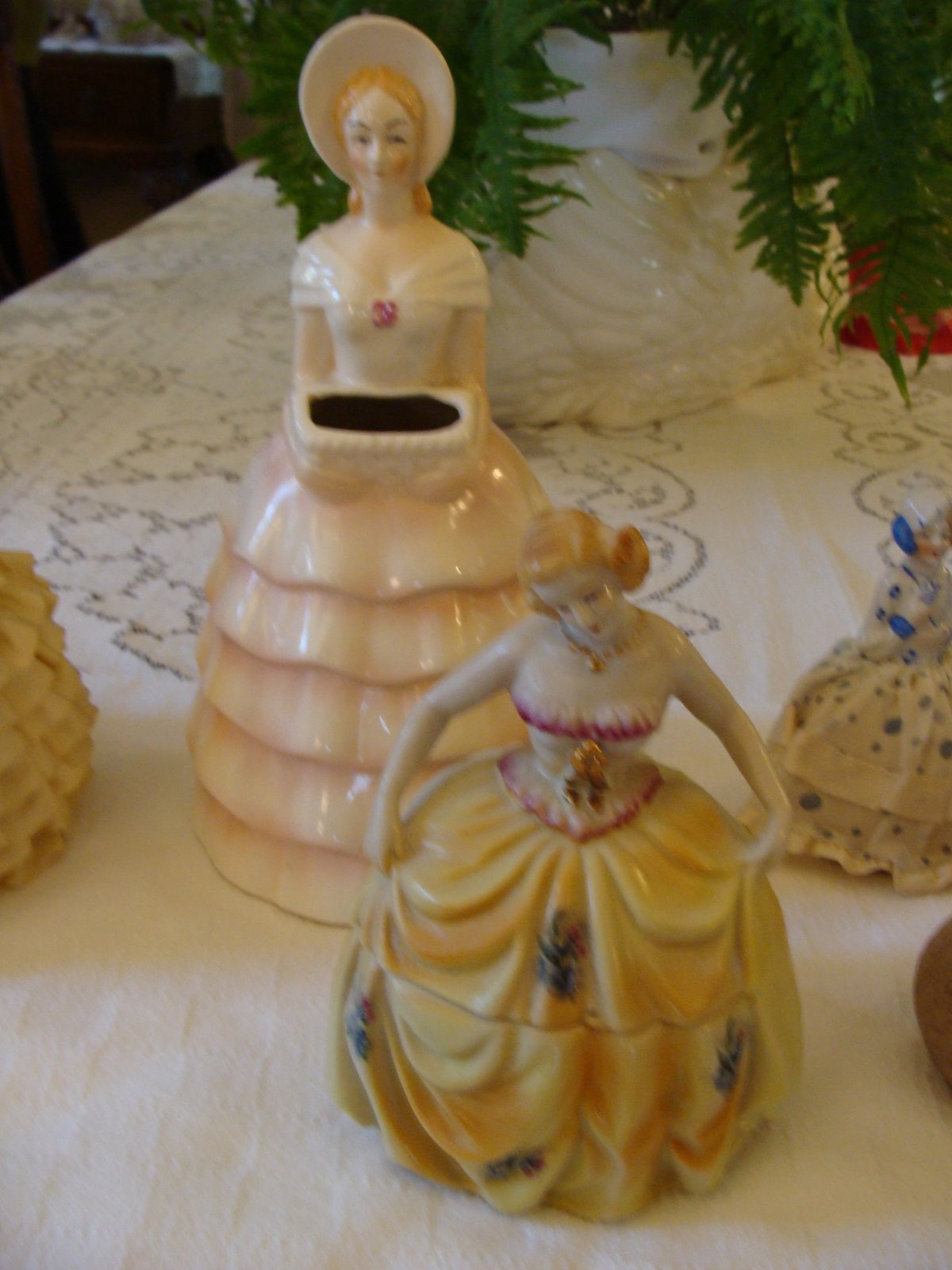
Our February program featured half-dolls as pincushions, candy holders, vases, porcelain containers, brushes, and just plain ornaments. We were amazed at the variety, and realized they are fun to collect. See the post below for information on half-dolls.
Posted by Picasa