StatCounter Code for Blogger / Blogspot -->

Friday, February 25, 2011

HOW TO WASH AND SET A DOLL WIG; IT IS EASIER THAN YOU THINK

Thanks to Dorothy for these instructions.  She has been doing doll repair for years, and is an expert.  I tried it on a Deanna Durbin wig, and it turned out great.

First consideration, is the cap strong and is the hair NOT rotten. Remove the wig as carefully as you can. Take out all pins and any other things that are there. Fill a bowl with cool water and add some Woolite or baby shampoo. Shake the wig to free it of as must dust as you can and then dip it into the bowl holding it by the center . Dip it up and down until it is good and soaked. Leave it in soak and lifting it up and down every so often. Do not disturb the wig anymore than necessary. After it soaks awhile, dump the water and rinse it in a fresh bowl. Continue the rinse until the water is clear. Next , fill the bowl with fresh water and add a conditioner . Dip the wig in the bowl. Squeeze the wig getting most of the water out and then lay it onto a clean towel and roll it in the towel. While the wig is still damp , put it on a ball or anything of the size of the doll's head. Try combing it some while it is still damp so it won't dry in a matted condition. You can be more direct after it dries. When dry, you can then glue it back on the doll., (A drop on the front, ,back and a drop over each ear should be enough. It is easy to style it on the doll. Comb small sections at a time. I use rollers for perms and using endpapers. When you have a piece combed out, wet the end paper and wrap the end of the hair and roll it. After all the hair is rolled, take a damp rag and touch all the rollers to get all the hair damp. DO NOT get the compo damp. You can blow dry if you like. When ready, gently remove the rollers trying to keep it in the rolled shape . You can gently arrange the curls with your fingers the way you like. I usually leave the rollers in over night. If the hair and cap are in good condition , the finished job should be great. This works for human hair, mohair, or synthetic, but never use regular shampoo for plastic hair. It takes forever to rinse. On all wigs, it is best to use a conditioner. You will lose a little bit of hair when you comb it. You can save it to patch other wigs that are sparse. If you scrub the hair like you do your own hair, you run the risk of felting it. Then it won’t comb out very well. Just remember to dip it up and down in the water, keeping the fibers separated as much as possible

One thing, this info is about composition and bisque dolls only.  Hard plastic and rooted hair dolls would not apply. You should wash their wigs while still on the doll. The hard plastic doll wigs are glued on with a special glue that is made to wash  while on the doll. If you try to remove a Toni doll wig you will tear it up. The Ideal Toy Co. spent a lot of time and research to develop a glue that would not come off while the child washed and styled it. The Md. Alexander Cissy and other hard plastics were trying for the same thing, but were not as good as Ideal, and therefor some have come off. I have had to reglue a lot of Cissys and other hard plastics because the glue failed..R&B s wigs seem to hold fairly well.  If you don't know the difference between hard plastic and composition, make sure of the material before you wash.


Thursday, February 17, 2011

HALF-DOLLS


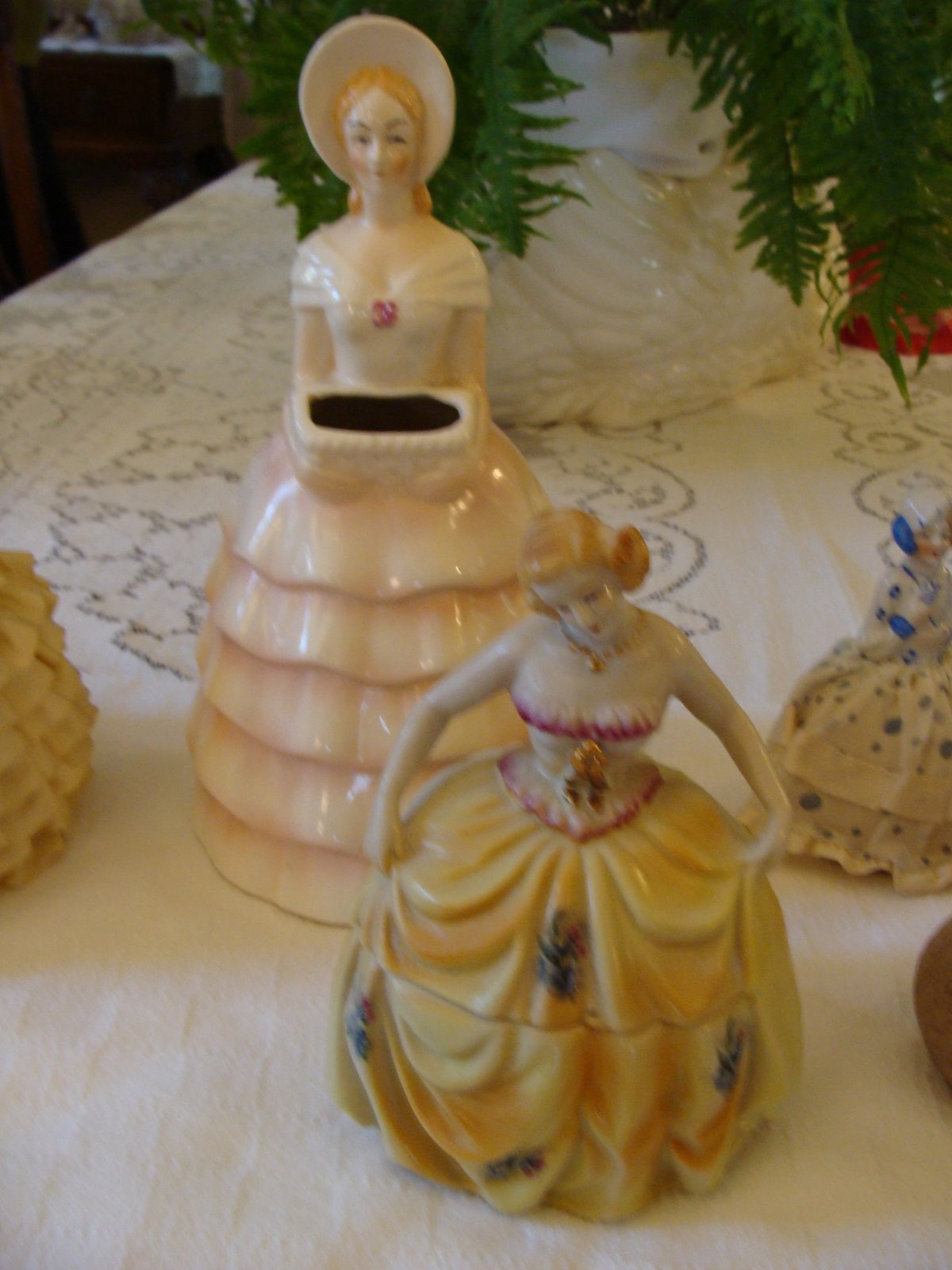
Our February program featured half-dolls as pincushions, candy holders, vases, porcelain containers, brushes, and just plain ornaments. We were amazed at the variety, and realized they are fun to collect. See the post below for information on half-dolls.
Posted by Picasa

MORE HALF DOLLS


Half-Dolls - February 13, 2011 Meeting at Debra's (Thanks for the informative program, Debra!)

Half-dolls are sometimes called half-dolls, pincushion dolls, pincushion figures, half-figures and other names. They were usually attached to items that served a utilitarian purpose, such as pincushiions, tea cozies, lamps, whisk brooms, powder puffs, powder boxes, and perfume bottles. While we can sometimes find the dolls still attached to their original item, many times we can only imagine their original purpose.

Half-dolls offer many positives to a doll collector. They are small and therefore require limited space and are easy to display. Common ones are easily found and are reasonably priced compared to other types of dolls. The more elaborate and rare models are more expensive, but they are quite a beautiful addition to any doll collection.

Half-dolls are classified into three basic types denoted by A, B, and C.

A. Dolls with arms molded into the body in one piece. They were easy and inexpensive to make, do not break easily, and therefore are the least expensive.

B. Half-dolls with arms extending away from the body and the hands returning to touch the body. This adds some support in the arms to prevent breaking.

C. Half-dolls with arms extending away from the body entirely. Theyt generally are very graceful and fragile. These are the most expensive.

Many half-dolls were modeled on famous historical ladies. Marie Antoinette, Jenny Lind, a Swedish singer, and Mrs. Siddons, a British actress, are some of the womenh that were featured. While not as common as the ladies, some half-dolls represented children, babies, male Pierrot, and female Pierrette. Other rare models include those with mohair wigs and those with moveable arms.

Many porcelain factories made half-dolls. Dressel, Kister & Co., F. & W. Goebel, Hertwig & Col, Carl Schneider, and Weiss, Kuhnert & Co. are a few that are known to have manufactured half-dolls. Some dolls have a specific maker's mark and many have only a mold number and "Germany."
Posted by Picasa

Friday, February 4, 2011

Doll Carving Class March 3-6 in Alabama

March 3-6, 2011, Doll Carving Class, Vestavia Hills, AL

Teacher: Janet Cordell, Master Carver for the state of Arkansas. To learn more about Janet and see her work go to www.janetcordell.com

What We’ll be Carving: Hitty, a 6 1/4" wooden doll based on the book, Hitty: Her First Hundred Years by Rachel Field. If you would like to carve something beside Hitty this is fine but please contact Janet ASAP to make arrangements for her to bring you a blank.

When: March 3-6, Thursday through Sunday from 9:00 until 4:00 with a break for lunch (on your own). You can stay later than 4:00 and carve and Janet will be available for assistance.

Where: We will be carving at my house in my basement. We carve in the double garage and set up tables. On this level, there is a finished room where we have coffee and snacks (got to keep our strength up) and a bathroom. It’s very easy to get around if you have a handicap.

Cost: The cost for the four day workshop is $250 with a $50 deposit which includes one blank. There are a limited number of places available so please let me know as soon as possible if you would like to take the class.

Contact Information:
Sharon Kirby
barbiesr@mindspring.com

Janet Cordell
janet_cordell@yahoo.com

http://www.janetcordell.com/gallery.html

Thursday, January 27, 2011

HOW TO MAKE THE BODY OF A CHINA DOLL (Double click to enlarge)


Here are instructions I used for many years to make bodies for the reproduction china dolls I used to make.  Pardon the stains.   It may seem difficult, but is readily understandable when you get into it. Many old chinas have deteriorating bodies that can't be saved, and it is acceptable to make a new body for them. I am about to make a body for an old bald china; I patched and patched her sawdust-filled body, and even considered covering it with a soft jersey material, but she was falling apart; therefore she will get a new body. I like to use cotton for stuffing, as the weight is right.
Posted by Picasa

Saturday, January 22, 2011

DOLL COLLECTOR LINKS

http://dolllinks.blogspot.com/

Here are many links to doll collecting - enough to keep you busy a while.  Some of the subjects are identifying dolls, photographing dolls, doll repair, and doll study.

Monday, January 17, 2011

CARVED WOODEN DOLLS


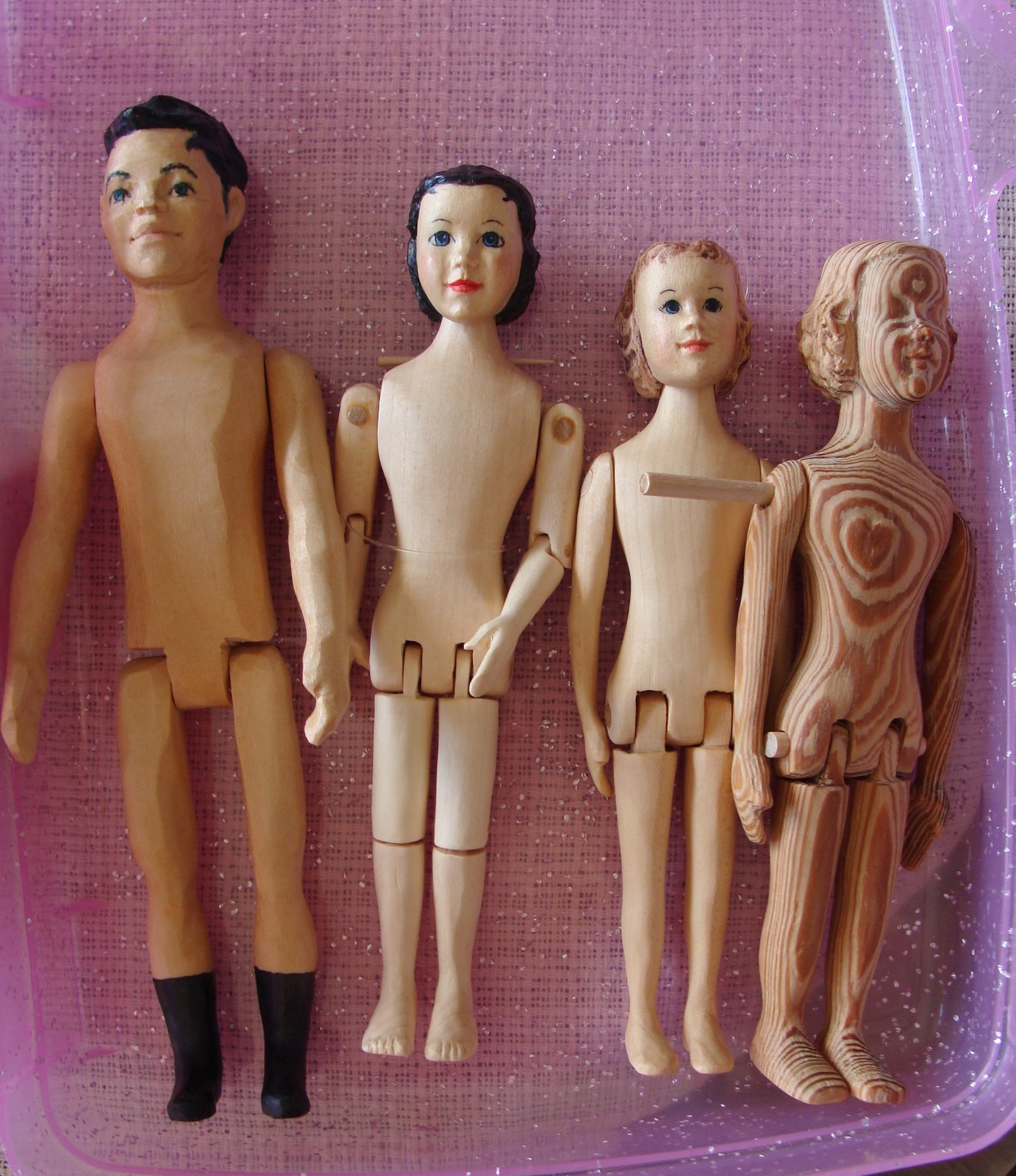
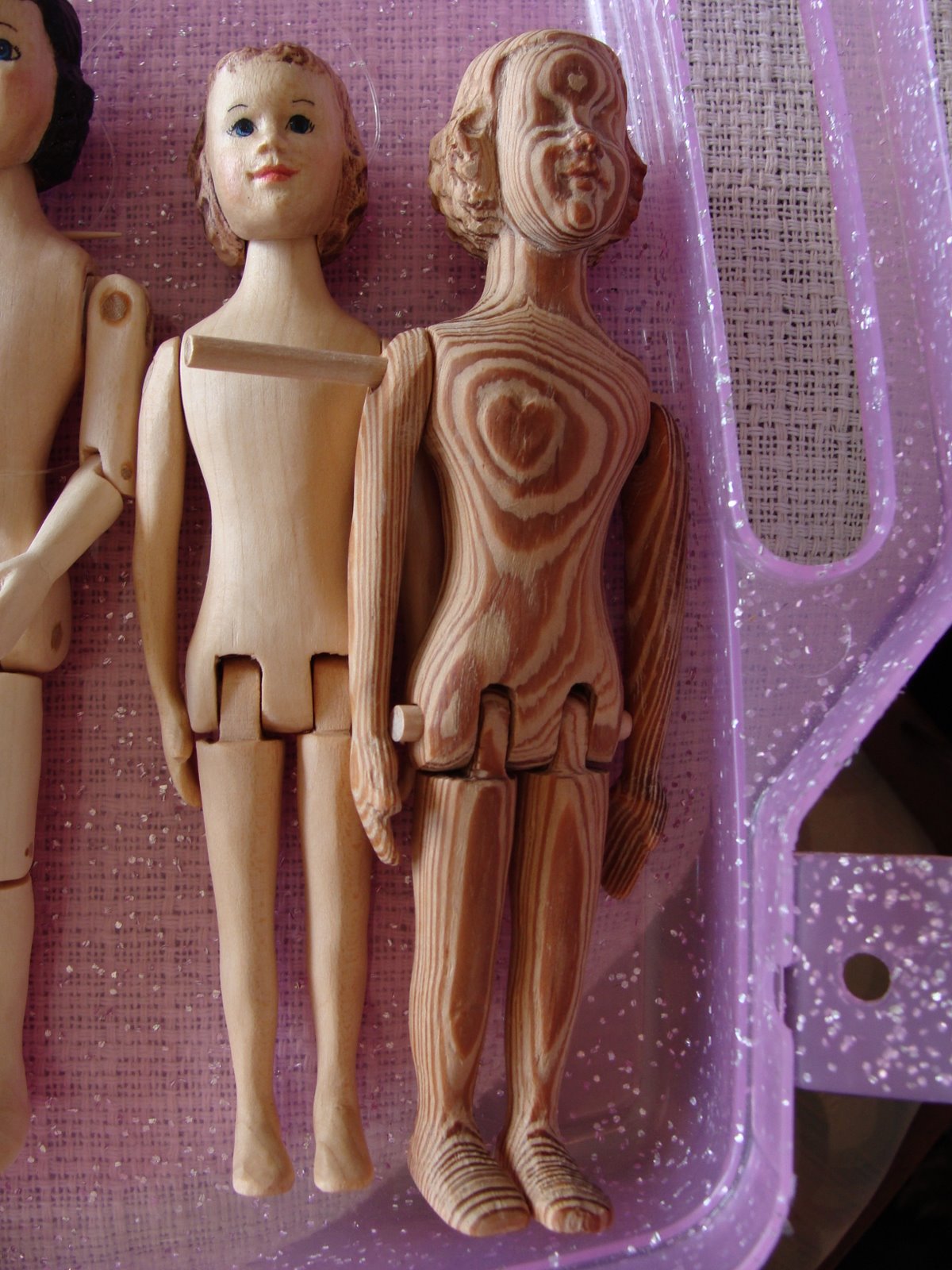
Here are hand carved dolls, based on the antique Hitty doll found in an antique shop years ago. Some of these were carved by Sharon, the one at bottom right, for instance. Notice the unusual wood. She says it smells sweet. Mock orange? Notice the heart shapes. The dress is made by smocking a vintage handkerchief. Really nostalgic, and a way to use those old hankies. The carvers usually start with a blank provided, and go from there. They are sanded, finished with a sealer and have features painted. Sharon doesn't want to paint the one with wood grain showing, except maybe a few facial features. Very unusual.

If you are interested in joining a carving workshop in March in Birmingham, AL, sponsored by the Birmingham Doll Club of AL, contact Sharon (see post below about carved wooden dolls).
Posted by Picasa

AMERICAN GIRL DOLLS


Here are Bitty Babies, the 18" American Girls, and the 6" American Girls. There are historical characters, and also the option of getting a doll to match your skin tones, hairdo, and clothes. What fun. You can take your American Girl to FAO Schwartz in NYC and get her a new hairdo. Yes, she sits in a beauty shop chair while getting her hair fixed.
Posted by Picasa

Monday, January 10, 2011

ARMAND MARSEILLES DOLLS


Stick legs of dollar doll.


Mold No. 370.


Mold No. 390 or Floradora.

Posted by Picasa

ARMAND MARSEILLES DOLLS


Mold No. 370 face. Watch for chubby cheeks on these dolls.


Mold No. 390 or Floradora doll.


Mold No. 390.

Posted by Picasa

ARMAND MARSEILLES DOLLS


Some of my girls!


The stunning 1894 /DRGM doll that many say was made for the French trade. This AM face is one of the most beautiful, in my opinion.


Sweet Dream Baby.
Posted by Picasa

ARMAND MARSEILLE DOLLS - Oct. 2010 Program

Here are Jill's notes from her informative A.M. program.  Her photos of A.M. dolls are posted above.


Armand Marseille dolls


doll club program Oct. 3, 2010


I have always found Armand Marseille dolls pretty, and they are practical in terms of availability and cost!

The period of the late 19th century through the early 20th century is often called the GOLDEN AGE of dolls. For a span of approximately 30 years, Germany was the doll making capital. Up until World War I, Thuringia, Koppelsdorf (an area in East Germany) supplied nearly 80% of the world production of dolls. Another factor contributing to the growth of doll making in Germany was that it was subsidized by the government. Also, the industry grew out of a work at home base so that anyone could get involved. Armand Marseille of Koppelsdorf at one time had the largest output of dolls of any company.

Located in Koppelsdorf, in the Thuringia region of Germany, the Armand Marseille doll company was at the heart of the German doll making revolution in the 1890’s manufacturing 1000 bisque doll heads a day from 1900-1930.


– Armand Marseille was born in St. Petersburg, Russian in 1856 – he was a butcher before being a successful doll maker. He was of Huguenot descent – hence, the French sound last name.


Marseille and his family moved to Germany in the 1860s – it was in 1885 that he bought the Koppelsdorf factory – and he changed his first name to Herman, from Armand. He also married Solveigh Heubach, sisiter of Ernest Heubach in 1891 – the Heubach connection would tend to explain why some fine AM dolls have a horseshoe mark on them - a mark which had historically been more commonly associated with the older Heubach firm.


By 1910 – 800 workers were in the factory and in home trade

Almost all of Armand Marseille’s doll heads were made of bisque – many other doll companies purchased AM doll heads. Doll bodies were generally made of composition or stuffed kid with bisque arms – interestingly, Armand Marseille did not make his own bodies.


American importers often called on AM-

4 of the largest NY importers sold AM dolls- Louis Wolf, Butler Brothers, Louis Amberg, and George Borgfeldt.

AM dolls were sold as promotional dolls –

Dollar doll – upper thighs lengthened /ruffles on dresses


The AM factory made dolls in all price ranges – and made the doll heads according to the BUYER’s price range.

Montgomery Ward – ordered cheaper doll – quality cut accordingly.

vs.

Louis Wolf- “first quality” doll – face painting, clothing, etc... were better.


In 1915, Armand Marseille Jr.‘s daughter Beatrice married the son of Ernst Heubach, again linking the two doll producing families -


1919 – AM porcelain factory and Ernst Heubach porcelain factory became United Koppelsdorf Porcelain Factory. Still made separate heads even though they joined forces.


The AM factory was torn down in 1994.

500,600,700 – series – very nice quality dolls

370/390 – read p. 6 P. Smith book.

1892, 1894, 1895, 1897, 1899, 1900, 1901, 1902 – AM mark

above with Horse shoe – E. Heubach

many heads are D.E.P. (registered) or DRGM – incorporated German Co.


Patricia Smith in her book mentions that she has never seen an AM doll with pierced ears!


Perhaps the most famous work by AM was My Dream Baby (marked 341) of the 1920’s – which rivaled the famous Grace Storey Putnam’s Bye-lo Baby.


Marseille made the famous Queen Louise doll which was registered in the US in 1910 by Louis Wolfe and Co. – The bisque of the Queen Louise is extremely fine with pale coloring and sleep brown eyes. Various versions had either painted or mohair lashes while some eyebrows were glossy.


Finally, despite the wide availability and sometimes inferior quality of the Armand Marseille dolls, they have made doll collecting possible for people with limited budgets and created some exquisite, lovely dolls!

Sunday, January 9, 2011

Carving in the Ozarks with Janet Cordell and Adina Huckins (CLICK ON PHOTO TO SEE ALL OF IT)

Last December, I had the privilege to go to a week long carving class in Winslow, Arkansas, taught by Janet Cordell and Adina Huckins. It was so much fun! Here are their websites if you would like to learn more about Janet and Adina and find out more information about their future classes. Janet will be coming to Birmingham, Alabama, in early March to teach a four day Hitty class.
http://www.adinahuckins.com/
http://www.janetcordell.com/

This is the "go-by" of the wooden baby doll that Janet carved for the Winslow class.
Photobucket

This is my Hitty I carved along with award-winning internet celebrities, Ellen and Pink, who were carved by TC Vollum.
http://www.dolltales.com/

Photobucket

Ellen and Pink think Hitty is so sweet!
Photobucket

Gorgeous Queen Anne/tuck comb style wooden doll carved by Adina Huckins.
Photobucket

We all stayed at the Sky-Vue Lodge, and this is the view I woke up to just about every morning!
http://www.skyvuecabins.com/
Photobucket

Happy Carving!
Sharon

Friday, January 7, 2011

BISQUE SHOULDER HEAD DOLL, CIVIL WAR CHINA, AND SIMON HALBIG SHOULDER HEAD DOLL


This 12" bisque shoulder head doll with kid body has blue glass eyes. She is unmarked, and her hair is molded with great detail.


Here is an 8" 1860's china doll with a flat top hairdo and exposed ears. She has unusual green boots, and wears a taffeta dress. Her pantaloons and petticoat are decorated with round thread cotton lace and entredeaux inserts


Here is a closeup of a Simon Halbig bisque shoulder head belton doll with glass eyes and pierced ears. She is perhaps one of the Little Women dolls S.H. produced in the early 1900's. If anyone knows, please let me know.
Posted by Picasa

SIMON HALBIG BISQUE AND CHINA WITH RARE HAIRDO


This 16" tall should head bisque girl with glass eyes, pierced ears, and belton head (bald) is unmarked, though attributed to Simon Halbig. She has bisque legs and arms and a tightly stuffed cotton body. She may be one of Simon Halbig's Little Women dolls.


This 12" china has an unusual face and rare hairdo with a bun in the back. She has pierced ears. She wears 2-piece outfit of brocade and lace, and has a cloth body with china arms and legs.
Posted by Picasa

Tuesday, December 14, 2010

CHRISTMAS SECRET SANTAS


Beverly with antique teddy bear doll (A.M.?).


Ann with felt Annalee Santa.


Barbara with windup singing church with lights.


JoAnn with angel figure.
Posted by Picasa